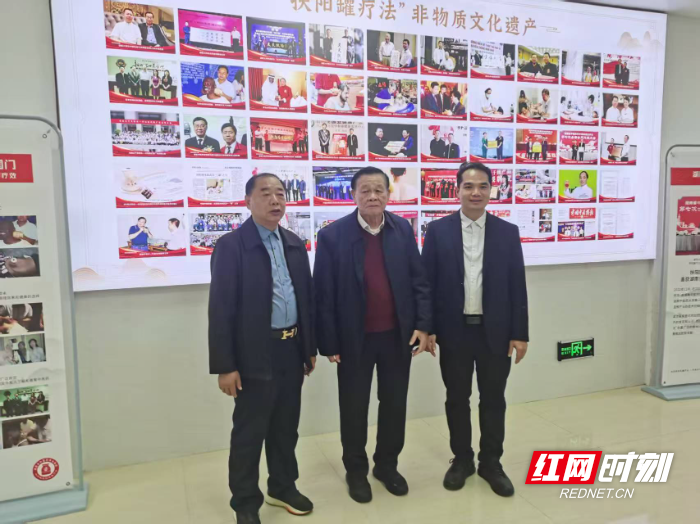
Recently, Master of Traditional Chinese Medicine Huang Jinming and his entourage visited Boda Traditional Chinese Medicine Hospital, the Guangxi Inheritance Base. They took part in exchange activities, experienced the intangible cultural heritage Fuyang Jar Therapy—a featured TCM regimen, and sampled elaborately developed TCM medicinal meals and herbal teas. The delegation offered professional and valuable guidance, charting the direction for the inheritance, innovation and development of traditional Chinese medicine.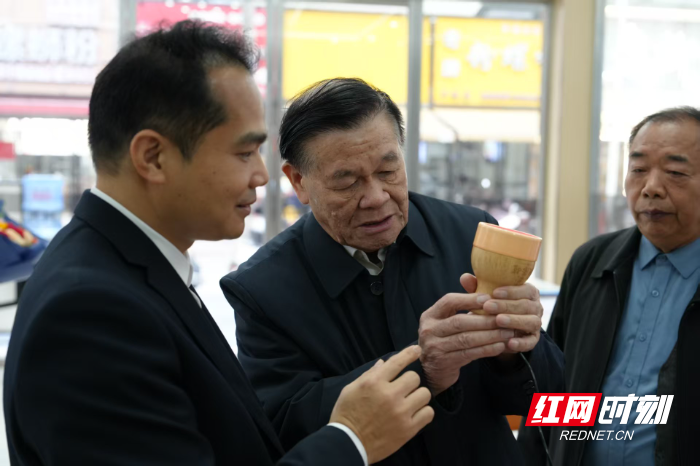 Huang Jinming is one of the"4th Batch Masters of Traditional Chinese Medicine", the "First National Famous TCM Doctor", and the "First Master of Guangxi School of Traditional Chinese Medicine". He also serves as a tutor for the academic experience inheritance program of national senior TCM experts in the "2nd, 6th and 7th batches". He is the first-generation representative inheritor of the **Guangxi Huang’s Zhuang Medical Acupuncture School**, one of China’s top ten acupuncture schools; the inheritor of the national intangible cultural heritage — "Zhuang Medicinal Thread Moxibustion Therapy"; and a Member of the Second Academic Division of the China Academy of Chinese Medical Sciences. He has been honored with the **National Outstanding Contribution Award in Traditional Chinese Medicine**, selected as a monthly figure of "China’s Good Doctor“|, and recognized as a representative contemporary master of Zhuang Medicine.
At the event, Master Huang Jinming closely observed the operation procedure of the Fuyang Jar Therapy before trying it out personally to experience its physiotherapy effects in detail.
As the hospital’s core characteristic TCM physiotherapy instrument, the Fuyang Jar is based on the TCM theory of "supporting yang". It integrates multiple traditional techniques including moxibustion, scraping, massage, magnetotherapy, and thermal therapy. Through the penetration of thermal effects into muscles and bones, it can effectively warm and unblock the meridians, dispel cold qi, promote blood circulation and remove blood stasis, and relieve problems such as limb soreness and cold intolerance caused by poor qi and blood circulation. At the same time, by stimulating body surface acupoints, it regulates the internal organs, helping to support healthy qi and eliminate pathogenic factors, and consolidate the root and cultivate vitality. It is suitable for conditioning cold-damp constitutions, rehabilitation of neck, shoulder, waist and leg pain, and daily health maintenance, boasting the advantages of being simple, convenient, effective, and affordable. The Master highly recognized its precise physiotherapy effects. Drawing on his decades of clinical experience, he put forward targeted professional suggestions on the intensity of Fuyang Jar techniques, the expansion of indications, and its combined application with other TCM therapies.
Subsequently, Master Huang Jinming sampled the TCM medicinal meals and herbal teas developed by the hospital based on classic prescriptions and modern health preservation concepts.
Formulated with authentic Chinese medicinal materials and strictly following the principle of "medicine and food homology", these teas retain the essence of TCM health preservation while taking taste into account, fitting the drinking habits of modern people. They received high praise from the Master, who commended them as an excellent practice for bringing TCM into daily life.
During the exchange, Master Huang Jinming emphasized that the inheritance and development of TCM must be rooted in classics, uphold tradition and pursue innovation. While adhering to the foundations of traditional techniques and theories, it should also integrate modern technology and lifestyles to enable TCM to better serve public health.
Relevant hospital officials stated that they will take this visit by the Master as an opportunity to absorb his valuable experience, further tap into the potential of Fuyang Jar Therapy, optimize operational standards, and upgrade the research and development of characteristic projects such as TCM medicinal meals and herbal teas.
 Huang Jinming is one of the"4th Batch Masters of Traditional Chinese Medicine", the "First National Famous TCM Doctor", and the "First Master of Guangxi School of Traditional Chinese Medicine". He also serves as a tutor for the academic experience inheritance program of national senior TCM experts in the "2nd, 6th and 7th batches". He is the first-generation representative inheritor of the **Guangxi Huang’s Zhuang Medical Acupuncture School**, one of China’s top ten acupuncture schools; the inheritor of the national intangible cultural heritage — "Zhuang Medicinal Thread Moxibustion Therapy"; and a Member of the Second Academic Division of the China Academy of Chinese Medical Sciences. He has been honored with the **National Outstanding Contribution Award in Traditional Chinese Medicine**, selected as a monthly figure of "China’s Good Doctor“|, and recognized as a representative contemporary master of Zhuang Medicine.
